

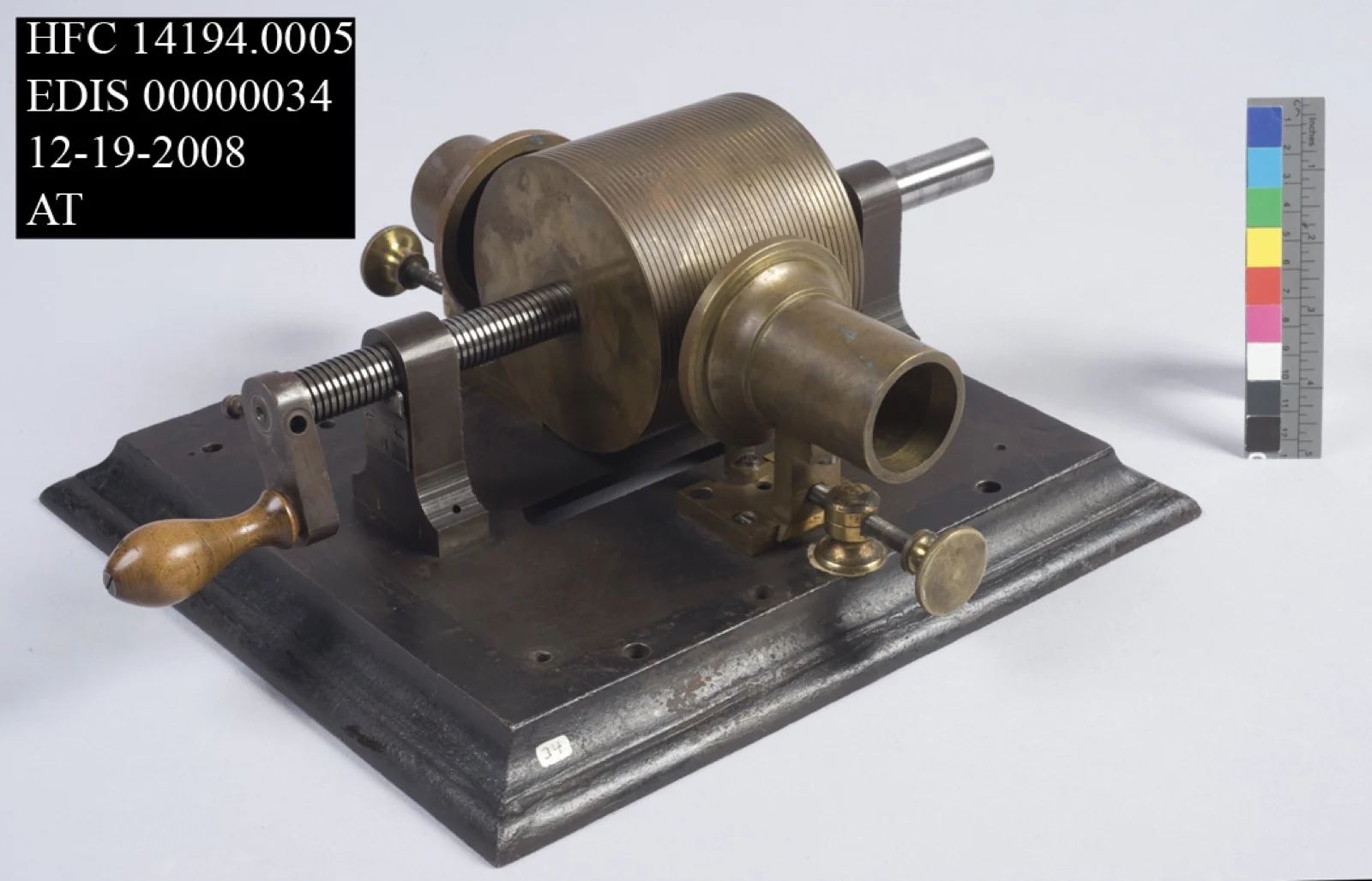
How the foil took a sound
A sheet of thin foil, wrapped around a cylinder turned by hand, was the whole recording medium. A stylus moved vertically against it, and the stylus was attached to a diaphragm, a thin membrane that responds to sound waves. Speak toward the diaphragm and it moves the stylus, which presses a pattern into the foil. That is the part worth holding in mind, because the foil did not store sound as a picture or a code. It kept physical impressions, small dents in metal made by a vibrating membrane, and it did so while someone cranked.
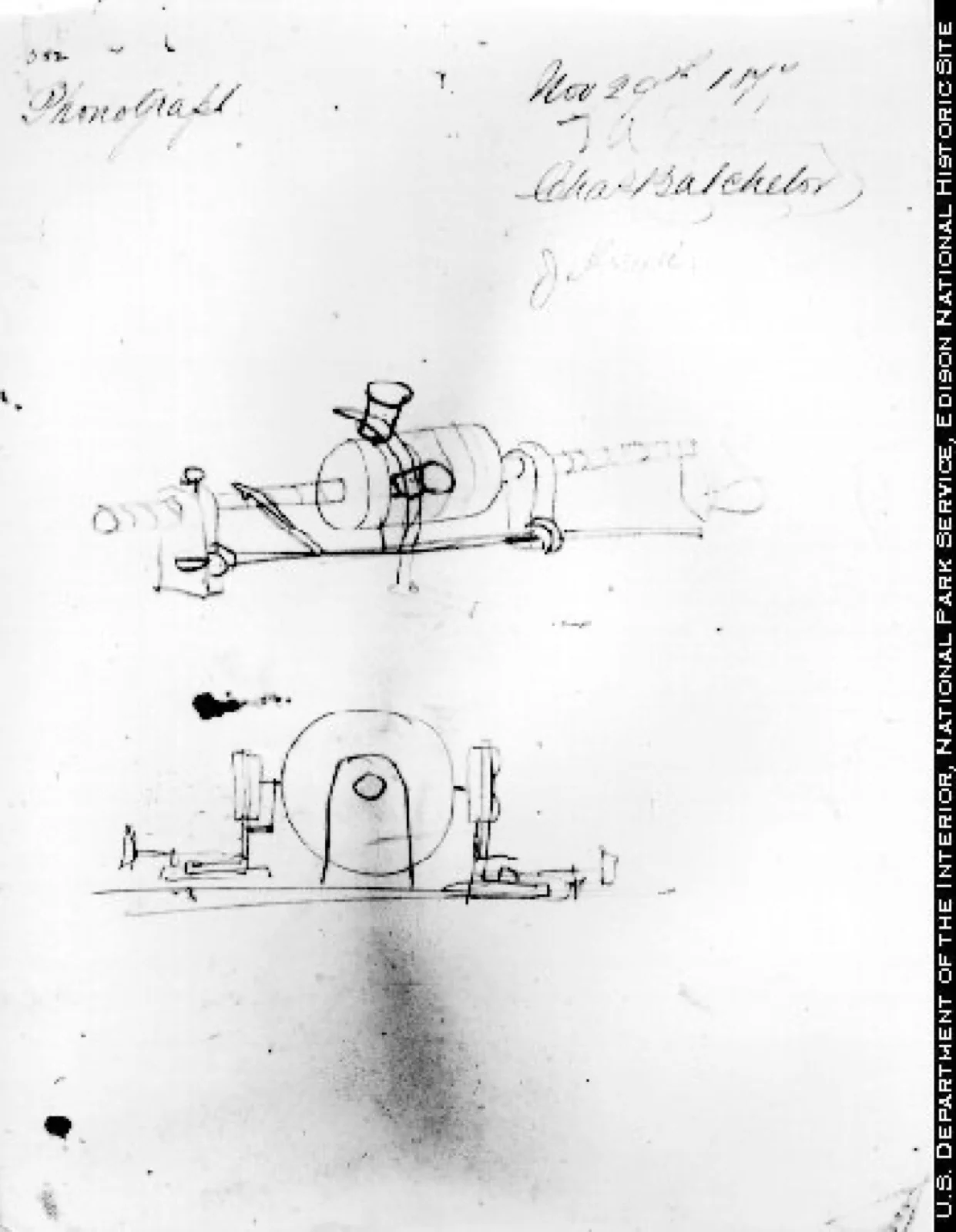
Playback ran the same chain in reverse. The recorded surface moves the stylus, and the stylus moves the diaphragm. The Library of Congress timeline places the idea's start in 1877, when Edison's work on a telephone transmitter inspired thinking about a device that could record and reproduce sound. The same timeline names machinist John Kruesi as the builder of the first tinfoil phonograph, working from Edison's sketches. A sketch is an intention, and the person who turned it into metal is easy to leave out of the tidy version.
The first verse and the other machines
A familiar line in this history is that Mary Had a Little Lamb was the first verse recorded on the machine. The Library of Congress says it was reportedly the first verse recorded on the tinfoil phonograph. The timeline gives no surviving capture of that performance. That gap matters for what the object meant. The story is easy to repeat because it is short and domestic, but a recording that cannot be replayed cannot show what it sounded like, how long it ran, or how well anyone could understand it. What survives is the claim, and the claim is the library's report, not an audio document.
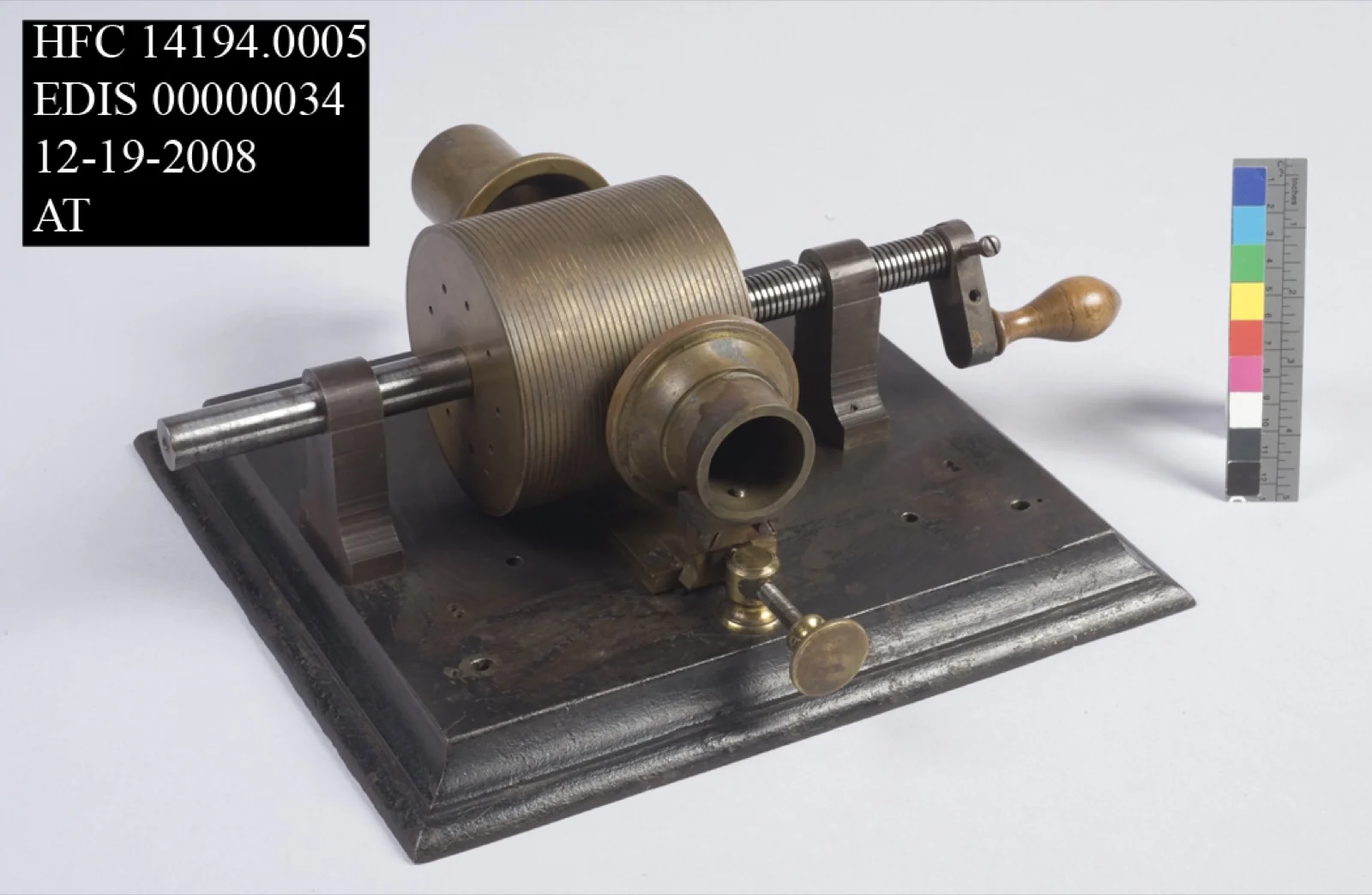
Another machine in the 1880s took a different route. Chichester Bell and Charles Tainter’s Graphophone used an engraved, wax-based cylinder instead of foil. The outside shape can make the two machines look like close cousins, but the surface that held the recording changed. The foil had to take the pressure of the moving stylus. The later cylinder stored its recording in wax-based material. One recording surface was a sheet wrapped around a cylinder. The other was wax-based material engraved to hold sound.
An envelope from St. Louis
The surviving foil from St. Louis is separate from Edison’s earliest trial. It arrived folded in an envelope with the handwritten date June 22, 1878, and a printed St. Louis address, 409 North Fourth Street. The registry essay by Carlene Stephens and Chris Hunter treats June 22 as the likely date of the demonstration. The lettering on the envelope and the impressions on the foil preserve different things. One gives the recording a date to investigate; the other lets people hear a little of what went into the machine.
The foil reached miSci in Schenectady, New York in 1978, donated by Helen Sweet Maier, and the National Recording Registry added it in 2020. While complete foils from the era are scarce, some demonstration foils were cut up and handed out as souvenirs. The more pieces a demonstration foil became, the less of its original run a later listener could hear. Even a complete foil can suffer damage when a stylus runs over it.
Recovery without a needle
That risk shaped the method. Conservator Gwen Spicer flattened the damaged foil. In 2012, Lawrence Berkeley National Laboratory physicists Carl Haber and Earl Cornell scanned its surface without dragging a needle over it, converting topographical images into audio. This is not the playback principle of the original machine. The 1878 device read impressions with a stylus. The laboratory method imaged the shape of the surface and converted that map into sound. The result is a reconstruction from physical evidence, and it is reasonable to call it a recovery, not a replay.
The recovered audio lasts 57 seconds. A cornet solo of roughly 23 seconds comes first, followed by two nursery rhymes, laughter and a rooster imitation. The machine was cranked by hand, so the speed wandered. David Giovannoni later addressed that unevenness. Recovery let the music and the voice be heard; correcting the speed helped the clip play at a more consistent pace.
Why a cornet carried
Why put a cornet in front of a phonograph? Stephens and Hunter describe how a cornet could carry the principal melody in a band and be heard through other instruments. They note that cornets appeared frequently at early demonstrations. The performer and title of the tune on this particular foil remain unidentified. It is possible to hear the instrument and still know very little about the person playing it.
A territorial business
The foil also belongs to a commercial setting. The registry essay describes the Edison Speaking Phonograph Company’s early exhibitions as territorial businesses, run by trained agents and promoted in local newspapers. It estimates around 100 trained agents in spring 1878. Exhibition rights cost an agent about $100, while admission cost 25 cents. H. H. Eldred and George Freeland Durant brought experience in telephone and telegraph work. Thomas Mason, who used the pen name I. X. Peck, operated the instrument. The company sent a phonograph to Mason in April and another to Eldred in May. In October 1878, the company allowed people to buy and exhibit the machines more widely.
Who Ran the Show and What Was Saved
Newspapers in St. Louis began announcing the phonograph exhibitions on May 30, 1878. The demonstrations ran at least through late June. The St. Louis Evening Post mentioned Peck showing the machine on June 17, according to the registry essay, before the date on the envelope. Stephens and Hunter suggest that Mason might be the voice on the foil. The announcements explain how someone could find a demonstration; the recovered recording captures the sound that made it worth visiting.
Turn the envelope over and it has a second piece of business on it. Stephens and Hunter identify an advertisement for M. J. Steinberg’s neighboring hat shop. It is a small thing to find beside a demonstration of a brand-new device. The invitation to see the exhibition fit on paper, with an ordinary business on the other side. The sounds themselves were in the foil.