

A November With Five Thursdays
The calendar page for November 1939 carried five Thursdays. November 1 fell on a Wednesday that year, which put Thursdays on the 2nd, 9th, 16th, 23rd and 30th. In most Novembers there are only four, and the last Thursday and the fourth Thursday are the same day. In 1939 the fourth Thursday was the 23rd. The last one was the 30th. That week between the two dates mattered when the president changed the observance.
The National Archives records that Franklin D. Roosevelt moved Thanksgiving to the second-to-last Thursday in 1939. The November calendar puts that Thursday on the 23rd. The Archives says sixteen states refused the change. The president's move set up two observances a week apart.
Sixteen is a count of state governments, not of households. It does not say how many families, in those states or any others, sat down on one date or the other.
Three documents carry the story from there: the 1939 calendar, a 1940 telegram and the 1941 legislative wording. They show different things. The calendar shows what dates were possible, the telegram shows a question people needed answered, and the wording shows the choice that was written into law.
What Last and Fourth Mean When November Has Five Thursdays
Last Thursday means the final Thursday on the page, however many come before it. Fourth Thursday means the one that is counted, and it always lands between the 22nd and the 28th. The last Thursday can land as late as the 30th. November gets a fifth Thursday only when it begins on a Wednesday or a Thursday. A Wednesday start puts the last Thursday on the 30th and the fourth on the 23rd, as in 1939. A Thursday start puts them on the 29th and the 22nd.
To find the fourth Thursday in any year, locate the first Thursday and add three weeks. In 1939 the first Thursday was the 2nd, and 21 days later is the 23rd. The last Thursday is the fifth when one exists, and otherwise the fourth.
Over the long run, two of the seven possible starting weekdays produce that split, so the wording matters in roughly two Novembers out of seven. In the other five, both wordings name the same day. That limit is worth keeping in view. The disagreement was real, but it had teeth only in certain calendars.
This year shows the quiet case. November 1, 2026 is a Sunday, so the Thursdays are the 5th, 12th, 19th and 26th, and last and fourth are both the 26th. The next five-Thursday Novembers are 2028, when the last Thursday is the 30th, and 2029, when it is the 29th. Under the fourth-Thursday rule, Thanksgiving falls on November 23, 2028 and November 22, 2029.
A Telegram About When to Serve the Turkey
Among the items in the National Archives' Thanksgiving exhibit is a telegram dated November 13, 1940, from Leota and Helen Care. The Archives describes it as a request to know when they should serve their turkey. The question is ordinary, and that is its value. The telegram asks about an ordinary decision people make before a meal, the day to prepare it.
The 1940 calendar had four Thursdays, the 7th, 14th, 21st and 28th. The second-to-last Thursday therefore fell on the 21st. The last one fell on the 28th. The two dates provide context for the telegram. The Archives account does not say why Leota and Helen Care asked their question.
Leota and Helen Care addressed the telegram to Roosevelt. They sent it on November 13, before either of the two Thursdays. The request came on November 13, in the middle of a month in which Thanksgiving still had two dates across the country.
The House Said Last, the Senate Said Fourth
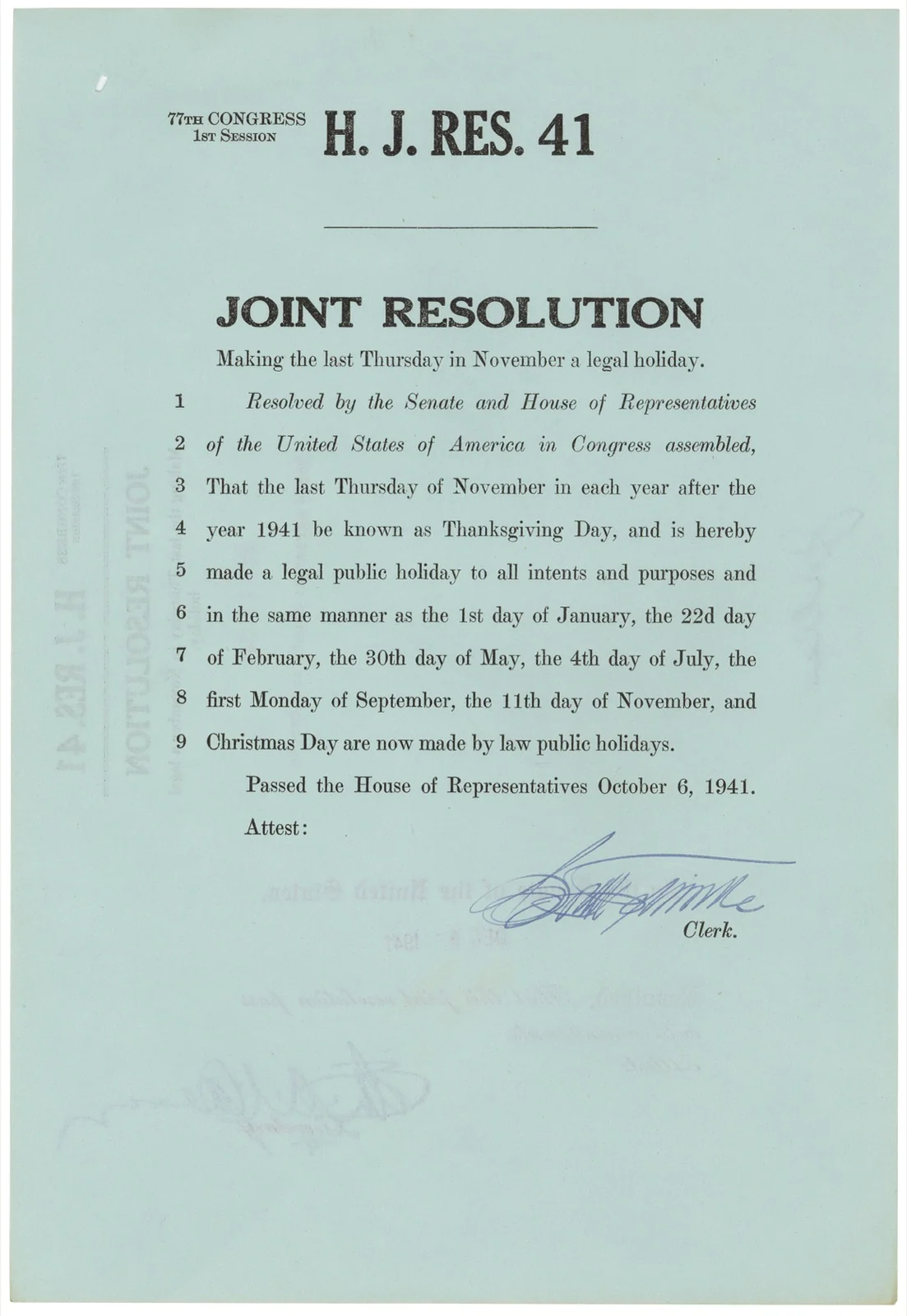
The National Archives' legislative feature on Thanksgiving shows the two chambers of Congress working from different wording. The House proposed the last Thursday of November. The Senate proposed the fourth, to account for the fact that November sometimes has five Thursdays.
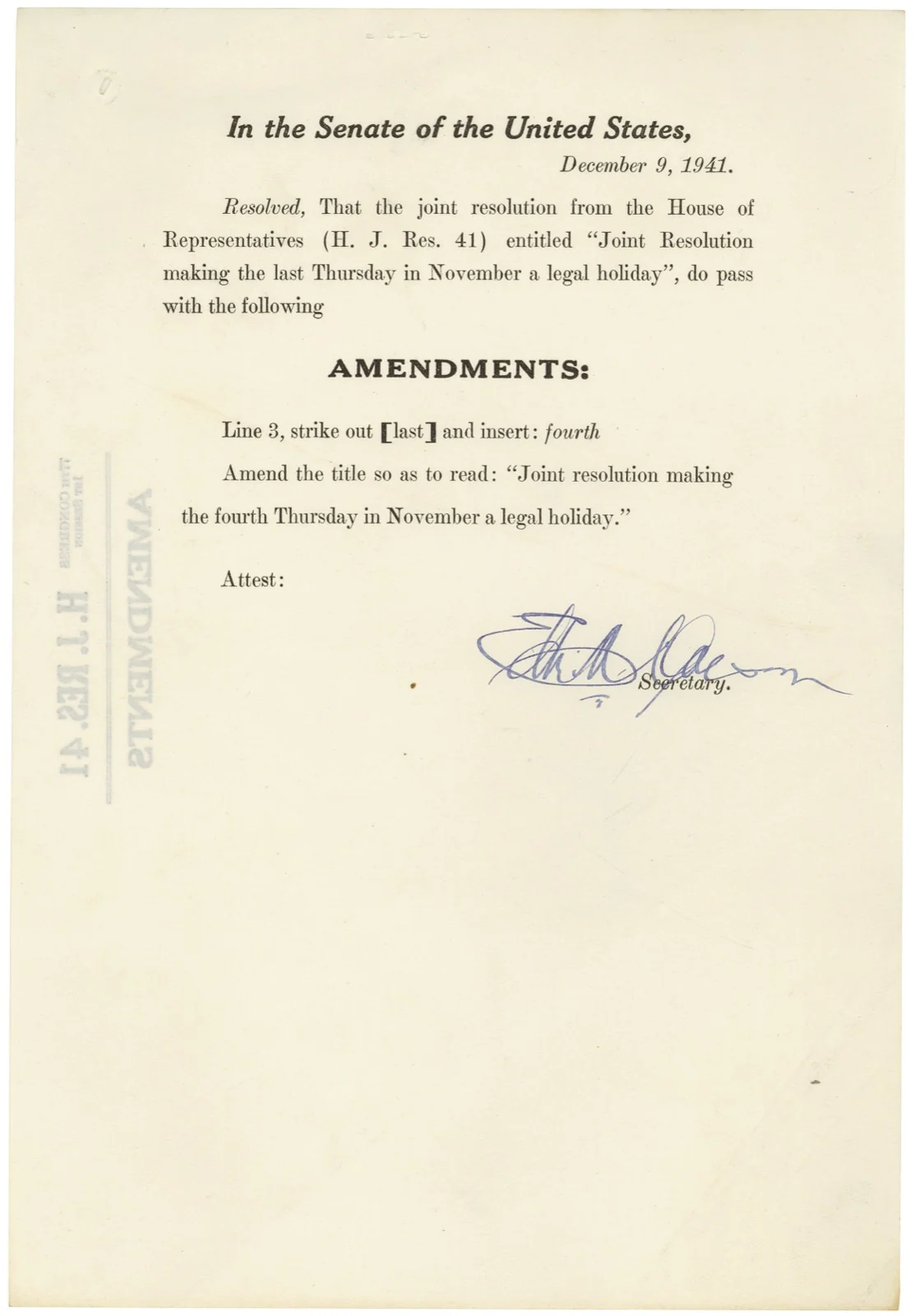
The Senate's wording would have named the 23rd in November 1939; the House's wording would have named the 30th. That older calendar makes a useful example of the difference between the two proposals. A rule that counts to four cannot drift to the 30th when a fifth Thursday appears. A rule that points to the end of the month follows the month to its final Thursday.
The Archives records the signing on December 26, 1941. The House had agreed to the Senate's amendment, and Roosevelt signed the fourth Thursday into law as the federal holiday. Keep those two dates straight: November is where the law places Thanksgiving, and December is when that particular wording was signed.
Presidential Action, State Observance and Federal Law
Three layers tend to get folded into one story. The first is presidential action: Roosevelt's 1939 move, as the National Archives describes it. The second is state observance: sixteen states refused that move, so what each of those states observed was its own call. The third is federal law: the signing on December 26, 1941, which put the fourth Thursday into federal law.
Roosevelt's decision also had a commercial calendar behind it. According to the National Archives, he worried that starting the Christmas shopping season so late in 1939 could hurt the economy’s recovery. The move put a week back into the stretch that retailers were looking at. A holiday about sitting down to eat was also a date that set off a different set of plans for shops.
The response happened state by state. The Archives counts 32 states issuing similar proclamations and sixteen retaining the later Thursday. That was enough to put both dates in use nationally. Both groups had issued their own proclamations.
The congressional wording did something different from either immediate response. It set an ordinal position for the holiday in every November. A later president could face a short shopping season, but when Thanksgiving fell in the month would no longer depend on choosing between the second-to-last and last Thursdays by proclamation.
What remains of Leota and Helen Care’s question is a telegram with a date, a recipient and a turkey to serve. Congress later supplied one federal holiday date. Read beside the two dates in use, the question offers a reminder that a date on a calendar is useful only after people agree what it means.