
A wind-up toy behind the glass
A wind-up toy holds a little surprise. Set it going and you can wait to see where it ends up. Put moving toys behind a pane of glass and a shopper could stop to watch from outside. The Library of Congress places an early example at Macy’s in 1874, when the store filled a holiday window with an animated scene of mechanical wind-up toys and dolls.
Think of a wind-up toy at table height, then imagine it behind glass. A window puts a small thing at the edge of a busy street, where someone can see it without going inside. You could stop for the toys, walk past, or come back for a second look. There is room in an ordinary errand for any of those choices.
Macy's own corporate timeline dates the shop's first holiday window to 1874 and its move to Herald Square to 1902. The Library of Congress lists Macy's among the first retailers to make a holiday display. For Macy's, that puts the mechanical figures in an early window at a different address, 28 years before the Herald Square move.
What window dressers could find in the trade press
Around 1900, window dressers had a professional association and a journal devoted to their work. The Library of Congress identifies L. Frank Baum as the editor of that journal, The Show Window, and as a founder and officer of the National Association of Window Trimmers of America.
Baum also published a manual on window dressing in 1900, the year The Wonderful Wizard of Oz appeared. His work with the association and The Show Window gave shop workers places to share a trade, while the 1900 manual put the work of arranging merchandise into a book.
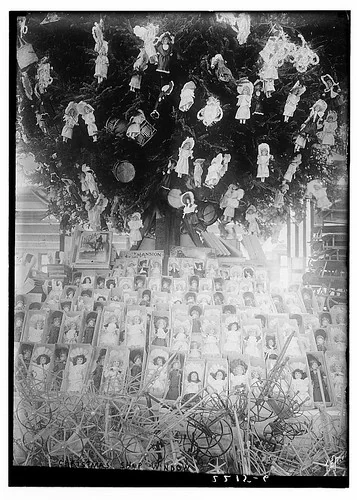
By 1909, nine years after Baum's manual, the trade press was passing display ideas and equipment between stores. The Library of Congress reproduces material from the Dry Goods Economist, a trade periodical, including an item on mechanical holiday displays from October 30, 1909, page 117, and handkerchief display ideas from November 13, page 81. Advertisements in the October issues offered hardware, specialized cases, fake plants and coat racks.
The trade paper shows the window dresser getting two kinds of help. In the articles, a dresser could see what a shop had tried. In the advertisements, they could see what was available to order. Think of the difference between wanting a pair of dolls to stand out in a display and deciding where to put the case they will stand in. One is an idea, the other is a choice about the room you have.
Compare two subjects the Dry Goods Economist covered that fall. In October, they printed a piece on displays that moved. In November, they printed ideas for dressing a window with handkerchiefs for Christmas. The difference is easy to appreciate from a shopper’s side of the glass. Movement can give you a reason to wait. A handkerchief has to catch your eye while sitting still. You might arrange a row of them so that one color interrupts the next, or give a single patterned square some breathing room.
The advertisements make the job feel tangible. The October 30 issue carried offers for cases from several makers, and the Library of Congress notes other equipment such as special skirt hangers, shelves and artificial plants. A hanger may sound unremarkable until you have a hem you want someone to see from the pavement. A shelf gives you another place to set the goods without having to build the whole window up from the floor.
The heading on the Dry Goods Economist's 1909 item about mechanical displays says the displays attracted crowds and sold goods. That language shows what the trade publication valued and what it told window dressers to expect. It is a claim made on the page, not a record of results. It cannot supply a sales figure, a head count of the crowd, or a reason why a particular person paused at the glass.
Two Seattle photographs from December 1965
A photograph supports only modest observations, such as what a walker could pick out from across the street and what needed a closer look. A 1965 photograph in the Seattle Municipal Archives shows the holiday lights at Frederick & Nelson from across the street. The lit windows run along the building at street level. From that distance, you can see their relation to the whole front of the store. You would need to cross the street to look closely at what any one window contained.
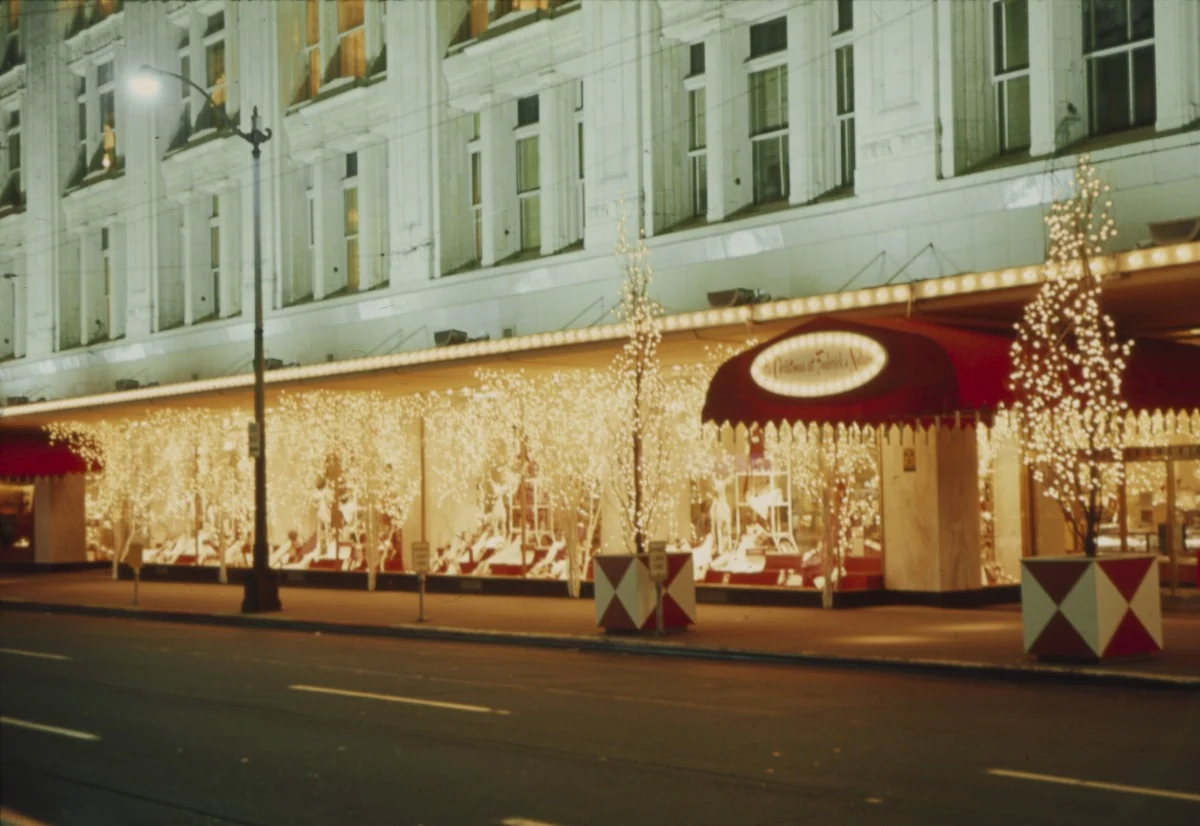
Another Seattle Municipal Archives photograph from December 1965 shows mannequins among lit trees. The item description leaves the store uncertain, so the photographs cannot be put together as two views of the same display. They do give two ways to start looking. One takes in a lit building from the far pavement. The other lingers on what has been arranged inside the frame.
Fairy tales on Fifth Avenue
Erin Allen had been looking forward to the department-store windows on a Thanksgiving visit to New York in 2014. Writing for the Library of Congress, Allen named Bergdorf Goodman, Saks and Lord & Taylor as favorites.
The Bergdorf Goodman windows Allen describes took up different arts. Allen mentions brass instruments in one window and portraits of writers in another. Put the two ideas next to each other and you can imagine the challenge for the dresser. How do you suggest a sound through glass? How do you make a roomful of portraits read as a window about books?
Allen describes Saks Fifth Avenue’s 2014 windows as Art Deco takes on familiar fairy tales. Cinderella went to Saks for glass slippers, and Little Red Riding Hood met the wolf at The Plaza. A person looking at those windows had two familiar things to pick out, a fairy tale character and a place in Manhattan.
The little changes to the stories are worth looking for. You might recognize the wolf first and register the hotel a moment later. Someone else might pick out the Manhattan landmark and then see which fairy tale had turned up there. Either way, a familiar detail does some of the work before you see the whole joke.
Lord & Taylor’s 2014 displays, also described by the Library of Congress, put mischievous mice, fairies in jars and animated pet portraits in an enchanted mansion. A window like that invites you to look for little events inside a larger scene. You might see the setting first and then linger over one of the details at the edges.
What to look for from the street
Imagine comparing the two scenes from the pavement. In 1909, the Dry Goods Economist wanted a window dresser to consider a display of Christmas handkerchiefs. In 2014, Erin Allen saw Cinderella shop for glass slippers in a Saks window. All those years apart, a handkerchief and a slipper are still small things to put in a big window. Each gives the eye somewhere to land.